Tampilkan postingan dengan label The Power of Football. Tampilkan semua postingan

Senin, 17 Juni 2013

Footballers at War: Royal Air Force

Liverpool legend Billy Lidell
After writing our blog, "Footballers at War: 1939-45" it seemed clear to us that the general topic was far too broad and too important to be confined to one Football History Boys piece. A recent article online from the RAF Museum Cosford, told of a visit from former Wolverhampton Wanderer Ron Flowers. Although Flowers was not present between 1939-45, he did undertake national service in the Air Force after his 18th Birthday, a feat unimaginable to today's youthful population. A number of Football League players did however join the RAF during the Second World War, each with stories, both heroic and tragic. 

The Royal Air Force, during the Second World War would provide an essential form of defence for the freedom and values of British life, no more exemplified than the infamous Battle of Britain in 1940. However, as discussed in a previous blog, the role of footballers in securing an Allied victory is often forgotten due to modern day image of greedy and self-obsessed professionals.


As we see today, pre-War football players were without doubt still the role models and icons for the nation's youth, be it  British or countries abroad. However, the pilots of the Royal Air Force would become the icons during the war, with heroes like Douglas Bader becoming a source of public hope and inspiration. Amongst the footballing stars involved with the RAF was Stan Mortensen (Blackpool winger), Leslie Lack and Bobby Daniel (both of Arsenal).

Bobby Daniell
Bobby Daniel's story is one of particular intrigue. At only sixteen-years-old he was a Welsh Schoolboy International, and within five years he was an RAF Flight Sergeant Gunner in a Lancaster Bomber, quite a difference from the original career path he thought he would undertake! However, Bobby's story is ultimately one of tragedy as during a bombing raid over Berlin on Christmas Eve, 1943 his plane was lost and never found again. According to the Commonwealth War Graves Commission he is one 20,000 other lost-in-action RAF servicemen remembered at Runnymede memorial.

The Liverpool illustrated history book from 2003 also mentions the role outside-right Berry Niewenhuys played in the war. Liverpool of course was city severely damaged by the Nazi Lufwaffe due to its industrial importing and exprting. Although South-African born, Niewenhuys would also join the RAF, before even attaining a Czechoslovakian Medal of Merit for his bravery on the Eastern Front of Germany. Berry's role in the Air Force was a PT Instructor as well as later captaining the RAF's side. During the War, it was common for football players to guest star for many different clubs (e.g. Arsenal and West Ham) as the main Football League was suspended whilst the Nation awaited the outcome of history's bloodiest conflict. Liverpool legend and Scottish-born Billy Liddell also signed up for the Royal Air Force and like Niewenhuys returned safely from operations in Europe.

Berry Niewenhuys
But what of the air forces both allied and against the British? Perhaps the most famous footballing member of the German Luftwaffe is Bert Trautmann. Trautmann would go on to earn five medals in the Nazi army during the first three years of the War, including the coveted Iron Cross. However, following capture in 1944, Trautmann decided against returning to his war-ravaged German homeland and instead settled in Lancashire before being signed by Manchester City in 1948 following impressive performances for local team St Helens.

"I had a good eye, good hands and good positional play. And, having been a paratrooper, I was quite agile."


Although initially met with some discord and animosity from post-war football fans due to his German past, eventually Trautmann won over the supporters due to some fine performances. Perhaps his most infamous moment in 545 matches for City was the 1956 FA Cup Final victory over Birmingham City, when he played the final 17 minutes of the match with a broken neck!!

“If I had known I had broken vertebrae I would have gone off but, not knowing and with no substitutes allowed, I played on."


Bert Trautmann broke his neck diving at the feet of Birmingham forward Peter Murphy
Trautmann breaking his neck! (Getty)
In keeping with the German Luftwaffe comes the "Death Match" played in 1942 between a Nazi air force XI (named Flakelf) and local Soviet factory workers (named Start). The Soviet team itself was made up of former professional footballers from Dynamo and Lokomotiv Kiev. Before the ninety-munites began the Soviet side was forced to greet the Germans with a Nazi salute, however in act of defiance, they refused. The game was hampered by dirty tactics of the Luftwaffe players, but most challenges were leniently viewed by the Nazi referee. The match was made famous by the Soviet propaganda machine as they promoted reports of the ten players being sent to German concentration camps due to the final score reading 5-3 to the former Kiev footballers. According to a Kiev newspaper six escaped, but four were killed. However, a 1974 investigation was unable to find any connection between the game and later executions.

Poster to advertise the "Death Match"

Within RAF communities and Air Force bases, football is still regularly played as a means of leisure for servicemen and women. Recently at Cosford, the RAF took part in a match against touring Australian forces with the British side emerging victorious after a 3-1 scoreline. As well as the continuing practice playing the beautiful game inside RAF bases, in recent years neighbouring professional football clubs like Doncaster Rovers have began to form tight bonds and educate supporters of the great deeds the Royal Air Force have done and still do this day.


So it would appear that the football players who joined the RAF at the start of the Second World War were every much heroes off the pitch as they were on it. Within this article only a handful of examples have been looked into some deeper detail. However, there are many more heroic footballing figures that could be talked about in future pieces. Bobby Daniel, Leslie Lack, Berry Niewenhuys and even the German Bert Trautmann should never be forgotten for the roles they played for their respective nations in what was Europe's darkest hour and hopefully can inspire the footballers of today to realise the importance of setting a better example and lasting legacy to the nations youth.


Jumat, 15 Februari 2013

1954 World Cup: The Miracle of Bern

The Mighty, Magical, Marvellous and Magnificent Magyars....It sounds like the start to the "Mighty Morphin' Power Rangers" but I can assure you these are just a few of the superlatives used to describe the Golden Team that represented Hungary between 1950-1956. In 1954 however, the World Cup and its Jules Rimet trophy arrived in Switzerland and the show piece event, the final taking place in the Wankdorf Stadium, Bern. Who would the Magyars face? West Germany. 8 years after the end of World War II and the collapse of Hitler's "Thousand Year Reich". The match would go down in History for the miracle it produced and the sheer power football can have... 

Puskas, Kocsis and Hidegkuti...the list goes on of world-class players and Hungary's disposal. From 1950, Gusztav Sebes had instilled a ruthless animosity to the Magyar's game. The attacking nature adopted by Sebes resulting in a 3-2-1-4 formation. From 1950-1956 the Hungarians would play 50 games...their record 42 wins, 7 draws and only a single defeat. The match they lost? The 1954 World Cup Final to West Germany. The story of the Miracle of Bern or Das Wunder von Bern is an amazing story for the way Germany won, but also how the Hungarians lost.

Match of the Century - England 3-6 Hungary
In 1953 the Mighty Magyars came to Wembley, expected to lose to an England team only defeated once to foreign opposition on home soil in over 60 years! The British press billed it as the Match of the Century - The world's finest team against the originators of the modern game. From the first minute of the match, the early form of "Total Football" was triumphing over the rigid nature of the English tactics. A Hidegkuti hat-trick, a brace from Puskas and a solo goal from Bozsik provided a brutal eye-opener for England and the tactical nous of the English game. The final score was 6-3 and a game without doubt living up to its pre-match billing. England even attempted to gain revenge before 1954, only to be humiliated again, this time on Hungarian soil 7-1.

The reason for the example of Hungary v England? To highlight the dominant, ruthless and unforgiving nature of the Eastern European side. Arriving at the 1954 World Cup, surely nothing could stop Hungary from taking the Jules Rimet trophy home, not least a West German side unseeded and an admittedly weakened side mercilessly beaten 8-3 in the first group stage by the Magyars. The 1954 tournament would be only the second World Cup to take place since the Second World War. The West German side only allowed to become a member of FIFA in 1950 and still feeling the force of European hatred for the events not long in the memory.

German hero Max Morlock
The routes to the final couldn't have been much different. Hungary and Germany both were drawn in the same group alongside South Korea and Turkey. Hungary were first to qualify, scoring a total of 17 goals in their two group matches - 9-0 vs Korea and the aforementioned 8-3 demolition of Germany. The West Germans needed a play-off victory over Turkey (7-1) to ensure qualification to the quarter-finals. The goals would not dry up in the knockout stages, Hungary defeated first a strong Brazilian team 4-2 and then reigning champions Uruguay by the same scoreline. Sandor Kocsis increasing his goal tally in the tournament to 11 in the process. West Germany gradually began to show form, firstly scraping past Yugoslavia, thanks to an own-goal and a late goal from Helmut Rahn, before showing their true pedigree by convincingly beating Austria 6-1 in the second semi-final. Max Morlock becoming the German pin-up boy in the process.

The scene was set. Hungary v West Germany, 4 July 1954, Wankdorf Stadium, Bern, The World's greatest team against the World's enemy. East vs. West. Capitalism vs. Communism.

Walter and Puskas - West meets East
8 minutes in? Hungary 2-0 West Germany, surely game over and another victory like that earlier in the 
tournament...an injured Ferenc Puskas and winger Zoltan Czibor supplying the sucker punches for the German team to deal with. Even it the "Fritz Walter weather" of torrential rain the Germans seemed to be drowning in a pool of Magyar pressure. However by the 18th minute the tie had transformed, complete with their Adidas boots (designed for any weather) the West Germans had brought the game level to 2-2, Morlock and Rahn scoring the goals and seemingly representing a team more than a match for their Hungarian counter-parts. Sepp Herbeger's side would hold almost the entire second half, Toni Turek making a string of saves to deny to "Golden Team". Then in the 84th minute, West Germany scored, the comeback was complete. Helmut Rahn provided the goal which 8 minutes in seemed impossible and provided the world's media with the headline "The Miracle of Bern".

Rough and tumble early on
The global reaction was that of disbelief, The Mighty Magyars had been defeated. The victors were the World's enemy West Germany. A wave of euphoria captured the West German states - not only for the victory but for what it would mean for its future. Historian Joachim Fest regards the triumph as a turning point for West German history, due to the new found respect from the final's global audience for its efforts to comeback from 2-0 down and 8 years of political, social and economic turmoil. The final in Bern was the first time the German anthem was played since the War, symbolizing the turning of the tide for Germany. West Germany would go on to win two more World Cups by 1990 and the Mighty Magyars would slowly decline due to their own countries problems and the gradual exodus of top players to escape the increasingly totalitarian communist regime Hungary was subject to. Recent studies have suggested that the West German victory may have been due to doping and Ferenc Puskas' 89th minute "equalizer" may not have been offside. Being a football purist I would like to think both were not true in order to bask in the memory in one of football's greatest games.

Pandemonium for Walter and West Germany
The lifting of the Jules Rimet Trophy by captain and former POW Fritz Walter really personifies the change in fortunes for West Germany and the resurgence after over 20 years of turmoil, dictatorships and millions of civilian deaths. Although West Germany would go on to receive another 36 years of instability, the efforts of Morlock, Rahn and Walter among others would go a long way in easing the hearts and minds of Germans and indeed the opinions of those who witnessed the "Miracle of Bern", further exemplifying the power football can have in uniting bonds deemed broken.


"AUS! AUS! AUS! Das spiel is aus! Deutschland ist Weltmeister, schlagt Ungarn 3 zu 2!"

(OVER! OVER! OVER! The game is over! Germany are World Champions, beat Hungary 3-2!)

Herbet Zimmermann

Ben Jones
Follow me on twitter - (@Benny_J)
www.top250.webs.com


Jumat, 08 Februari 2013

1974 World Cup: East Meets West

In 1946, Winston Churchill declared that an iron curtain had descended across Europe. This was in reference to the the split that had occurred after the end of the Second World War where the Soviet controlled east became a Communist, totalitarian regime whereas the west was considered more democratic. Germany and it’s capital Berlin was split in half too, East Germany becoming the German Democratic Republic (don't be fooled by the name!) while the West was named the Federal Republic of Germany. This led to years of tension with tight restrictions on most areas of life in the East, football included. Professional clubs were banned and players were picked on if they were considered good role models rather than talent (maybe something we could do with today eh?!)
Probably wouldn't be playing for GDR!
The West was a different case, it was considered an economic miracle and grew rapidly, many Eastern Germans flooded across the borders to the Allied zones in desperation and in 1961, to stem the drain on Eastern resources, the Soviet union constructed the Berlin Wall. Two worlds were created, including in footballing terms with the West’s professionals Bayern Munich dominating much of the late 1960s/70s while Eastern amateur clubs languished behind. 

In 1972 the UEFA European Championships were won by star laden West Germany, containing the true footballing legends of Gerd Muller, Paul Breitner and Franz Beckenbauer. The next big step in the countries short history was to host the 1974 World Cup. It must be noted that moves towards reconciliation were in place and the countries formally recognised each other in the Basic Treaty at the beginning of the decade but worries remained across the continent, especially after events like the Palestinian terrorist attacks at the 1972 Munich olympics. Both sides qualified for the competition and the group draw for the first round proper pulled out a cracker, GDR, FRG, Australia and Chile. For the first time in serious competition (the had played in the Olympics but these were only amateur games) the two teams would meet! 


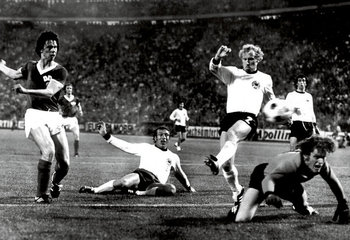
Franz Beckenbauer and Bernd Bransch

This was the tie of the tournament no doubt about it but was seen as the “brotherly” match, gripping not only football fans but whole countries who saw this as a chance to united a divided nation. Things were helped by the fact both sides had already qualified for the second stage of the tournament. This was the final group game and was played in a good spirit with only 3 bookings throughout the match, the West though firm favorites and they knew it. Bayern Munich had won the European Cup weeks before beating Atletico Madrid in the final but FC Magdeburg of the East were also winners of the European Cup Winners’ Cup after victory of Milan. This was going to be one tasty game!!   

 All 1,500 of the specially selected East German fans piled into the stadium of 60,000 (the only ones allowed, similar to North Korea World Cup 2010 who sent Chinese actors!). The game itself did not live up to its billing however with both teams not really creating much of note, everyone believing the West would nick it at the end. In the 77th minute though, something unexpected happened... A long ball was well controlled by East German striker Jurgen Sparwasser who beat 3 West defenders and rifled the ball past Sepp Maier , incredible scenes!! (video below)


The result stood at full time breaking the heart of West German manager Helmut Schon who was one of those East German’s who had escaped across the border to the West to further his career. Rumor has it he lost all motivation and Franz Beckenbauer effectively helped guide the team for the rest of the tournament. The win though was probably the downfall for East Germany, they topped the table and so for the next stage were placed into another group with Brazil, Argentina and the Netherlands while West Germany only had to face Yugoslavia, Sweden and Poland

The Wall comes tumbling down
The final was between West Germany and the powerhouse of “Total Football” that was Netherlands. Two giants of World football that eventually saw Federal Republic of Germany win 2-1 thanks to goals from Breitner and Muller. Until Vincente del Bosque with the current Spain squad Schon was the most successful international manager with a record of 1 world cup win and 1 European Championship as well as coming runner up in both too. For East Germany it was a moment of triumph, the only side to beat their Western counterparts during the World Cup and a kickstart to the 1976 Olympics where they won the gold. This would be the only time the two met, drawn to be in the same Euro 1992 qualifying group the Berlin Wall came down and the country was reunited just before. This is certainly a moment to remember from the history of the beautiful game, something that seems a world away from the Europe we know now but also something that really wasn't that long ago, what a story!


Gareth Thomas TFHB (Follow me on twitter: @GJ_Thomas)

Be sure to visit our website too, Top250!

Sabtu, 02 Februari 2013

Beckham to Paris: Performance or Popularity?


Beckham answering questions at Thursday's press conference

With the transfer deadline slamming shut in its usual over-hyped way,the headlines on the papers sports pages the next day were an overrated Samba's move to QPR, a player failing to force a move and the odd exotic loan deal for the top clubs younger players. The front and back pages however were filled to the brim of the free transfer of David Beckham.


Paris Saint Germain looks to be his final destination In football. At the age of 37 many forget that he is only a year or two younger than the elder statesmen, Giggs and Scholes. Who's performances are slowly decreasing at Old Trafford, rarely will you see them on the same pitch at the same time. In the summer of 2011,

PSG Star man Zlatan Ibrahimovic
Qatari business man Sheikh Tamim Bin Hamad Al Thani bought a 70% stake In PSG and soon started his own French Revolution, bringing in the household football names of Menez, Ibrahimovic, Thiago Silva, Lavezzi, Pastore and Thiago Motta for a combined fee of around £130 million among many others. In January 2013 they completed the long arranged deal for 20 year old Brazilian Lucas Moura for a staggering 40 million Euros. He joins a group filled with promising youngster's Mamadou Sakho, Marco Verreti and 2010 World Cup final starter Gregory Van der Wiel.


So where does Beckham fit in? the squad is brim full with talent, top of the French league, cruising a difficult champions league group with an impressive 15 points and looking like a potential favourite to lift both trophies. So why sign a 37 year old for 6 months in a team where he would struggle to get into the rotting talent still floating around the reserves, from before the takeover.
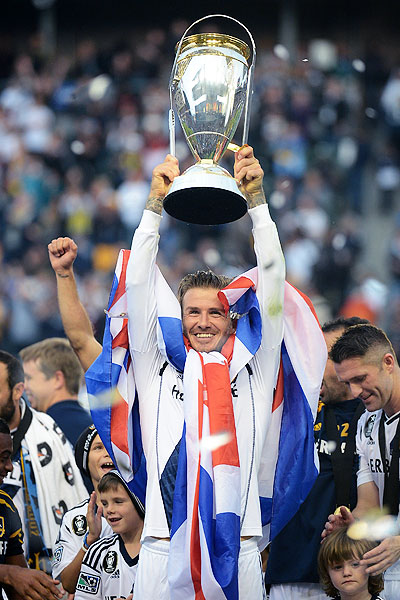
Beckham holding aloft the MLS Cup

Beckham is being paid 3 million in wages over the 6 months, a fee that will kindly be put straight into a children's charity in Paris. The long run popularity PSG will gain across the world from signing Beckham is worth probably around 10 times more what there paying him. In shirt sales alone Beckham shirts will sell by the hundreds of thousands at £40 a pop. In his time at America before he had even been unveiled as a LA galaxy player, The club announced 250,000 Beckham shirts had been sold, an intake of around 1 million pounds. Tv rights, adverts, sponsorship and an increased fan base are the real money makers for PSG. After his first game for the club people in the USA, China, Japan, the UK, and Africa in fact almost every country around the world will know Beckhams new club and those previously unaware of there successes and acquisitions will be forced to listen by the sheer might of "brand Beckham". 


After playing substandard football in the USA in a league where the quality is closer to the A league in Australia than the brutal nature of the Champions league that can even make the best players look exceedingly average this will be a massive perhaps unmanageable step.. Gone are the days of the wonderfully floated crosses and "that goal" against Greece. These days it's all about brand Beckham and the money golden balls can bring.

By James Cartwright (The Football History Boys)

Entri Populer

Diberdayakan oleh Blogger.


© 2013 TOPSCORE AND NEWS. All rights resevered. Designed by Templateism

Back To Top