Minggu, 09 Februari 2014

The Top 250 Players of All-Time: 160-151

In February 2013 up in the attic bedroom of our student house, Gareth Thomas, Ben Jones and Ollie Jackson after another prolonged football debate decided it was time we did something about the question, 'Who is the best player in the World?'. Housemate Liam suggested setting out to find the greatest 50 players of all time, this swiftly grew to 100, 150 and 200 before we settled on 250. Our original website www.top250.webs.com is still there to answer the debate but we furthered our work to blogging about the beautiful game starting up www.thefootballhistoryboys.blogspot.com.

Missed the last installment? Find it here!


160. Glenn HODDLE


POSITION: Midfielder; 

NATION: England (53/8); 


CLUB(s): Tottenham Hotspur (ENG), Monaco (FRA), Swindon Town (ENG), Chelsea (ENG)


CLUB HONOURS: 1x UEFA Cup, 2x FA Cup, 1x FA Community Shield, 1x Ligue 1, 1x Coupe de France

"The former Tottenham Hotspur and Monaco maestro is hailed by many as the best creator that the English game has produced in a generation and the cliché goes that any other nation would have built their national side around him." www.goal.com


159. Fernando TORRES


POSITION: Forward; 

NATION: Spain (106/36) (As as Feb 2014); 

CLUB(s): Atlético Madrid (SPA), Liverpool (ENG), Chelsea (ENG)

CLUB HONOURS: 1x Segunda Division, 1x FA Cup, 1x UEFA Europa League, 1x UEFA Champions League

INTERNATIONAL HONOURS: 1x FIFA World Cup, 2x UEFA European Championships

"El Niño was a goalscoring machine for the Reds, a natural heir to predecessors Robbie Fowler and Ian Rush in the iconic No.9 shirt, with his prolific finishing and unquenchable thirst to find the back of the net thrilling Kopites for three-and-a-half years... His impact was instantaneous, with an exquisite finish on his Anfield debut against Chelsea setting the tone for a season in which Torres would surpass the 30-goal mark and evolve into the focal point of Benitez's master plan" Liverpool FC's 100 Players Who Shook The Kop - #9


158. Laurent BLANC


POSITION: Defender; 

NATION: France (97/16); 

CLUB(s): Montpellier (FRA), Napoli (ITA), Nîmes (FRA), Saint-Étienne (FRA), Auxerre (FRA), Barcelona (SPA), Marseille (FRA), Internazionale (ITA), Manchester United (ENG)

CLUB HONOURS: 1x Coupe de France, 1x Ligue 1, 1x Supercoppa de Espana, 1x UEFA European Cup Winners' Cup, 1x Copa del Rey, 1x Premier League

INTERNATIONAL HONOURS: 1x UEFA European Under-21 Football Championship, 1x FIFA World Cup, 1x UEFA European Football Championships

"As a player, Laurent Blanc was one of France's most loved and respected servants - a composed and calm sweeper who read the game superbly and was big and physical, he was a key component of the side which won the 1998 World Cup and Euro 2000." www.extrafootie.co.uk


157. Sami HYYPIA


POSITION: Defender; 

NATION: Finland (105/5); 

CLUB(s): PaPe (FIN), Kumu (FIN), MyPa (FIN), Willem II (NED), Liverpool (ENG), Bayer Leverkusen (GER)

CLUB HONOURS: 2x Finnish Cup, 2x FA Cup, 2x League Cup, 2x FA Community Shield, 1x UEFA Champions League, 1x UEFA Cup, 2x UEFA Super Cup

"Liverpool's decision to part with £2.5million to secure the services of Finnish defender Sami Hyypia during the summer of 1999 will forever rank as one of the smartest pieces of business the club has ever conducted. Robust and powerful, dominant in the aerial challenge and a consummate reader of the game, the centre-back was an efficient footballer at the same time - comfortable in possession and a threat in the opposition penalty area." Liverpool FC's 100 Players Who Shook The Kop

156. Jaap STAM


POSITION: Defender; 

NATION: Netherlands (67/3); 

CLUB(s): Zwolle (NED), Cambuur (NED), Willem II (NED), PSV Eindhoven (NED), Manchester United (ENG), Lazio (ITA), AC Milan (ITA), Ajax (NED)

CLUB HONOURS: 1x Eredivisie, 2x KNVB Cup, 4x Johan Cruijff Shield,  3x Premier League, 1x FA Cup, 2x League Cup, 1x UEFA Champions League, 1x Intercontinental Cup, 1x Coppa Italia, 1x Supercoppa Italiana

"During his time at Old Trafford Jaap Stam was arguably the best defender in the world. He played a crucial part in Manchester United's amazing treble winning season, culminating in that magical night in Barcelona when United beat Bayern Munich to win the Champions League. Immensely strong, a brilliant ball-winner and possessing a fantastic awareness that allowed him to break down attacks before they began, Jaap Stam was described by Dutch legend Johan Cruyff as "a one-man defence". www.icons.com


155. Zbigniew BONIEK


POSITION: Forward; 

NATION: Poland (80/24); 

CLUB(s): Widzew Lodz (POL), Juventus (ITA), Roma (ITA)

CLUB HONOURS: 2x Ekstraklasa, 1x Serie A, 2x Coppa Italian, 1x UEFA European Cup, 1x UEFA Super Cup, 1x UEFA European Cup Winners' Cup, 1x Intercontinental Cup

"Zibi Boniek is one of the greatest Eastern European players ever. He started his career in his birthtown club Zawisza before moving to one of the great Polish clubs, Widzew Lodz. Boniek was included in Poland’s 1978 World Cup squad as a 22-year-old and impressed many with his tireless running and commitment... Four years later in Spain, Poland had a better team and Boniek was excellent as his country won bronze medals. Arguably his best performance of his career for Poland came in a second phase match against Belgium where he scored a magnificent hat-trick. One of the best hat-tricks in World Cup history." www.planetworldcup.com


154. Bryan ROBSON


POSITION: Midfielder; 

NATION: England (90/26); 

CLUB(s): West Bromich Albion, Manchester United, Middlesbrough (All ENG)

CLUB HONOURS: 2x Premier League, 3x FA Cup, 1x Football League Cup, 3x FA Charity Shield, 1x UEFA Cup Winners' Cup, 1x UEFA Super Cup, 1x Football League First Division

“He was a miracle. A human marvel who carried an aura about him.” Sir Alex Ferguson


153. Graeme SOUNESS


POSITION: Midfielder; 

NATION: Scotland (54/4); 

CLUB(s): Tottenham Hotspur (ENG), Montreal Olympique (CAN), Middlesbrough (ENG), West Adelaide (AUS), Liverpool (ENG), Sampdoria (ITA), Rangers (SCO)

CLUB HONOURS: 1x Football League Second Division, 5x Football League First Division, 4x Football League Cup, 3x FA Charity Shield, 3x UEFA European Cup, 1x Coppa Italia, 3x Scottish Premier League, 4x Scottish League Cup


"A bear of a player with the delicacy of a violinist - that's how one onlooker once eloquently described Graeme Souness. It fitted the bill perfectly, for here was a fearless midfield general who, despite a reputation as a hard man, possessed the most subtle of touches." Liverpool FC "Past Players"
http://www.youtube.com/watch?v=ygVgxYa3mlo - Here he is showing off that 'hard man' reputation!

152. Luis SUAREZ Miramontes


POSITION: Midfielder; 

NATION: Spain (32/14); 

CLUB(s): Deportivo La Coruña (SPA), CD Condal (SPA), Barcelona (SPA), Internazionale (ITA), Sampdoria (ITA)

CLUB HONOURS: 2x La Liga, 2x Copa del Rey, 2x Inter-Cities Fairs Cup, 3x Serie A, 2x UEFA European Cup, 2x Intercontinental Cup

INTERNATIONAL HONOURS: 1x UEFA European Championship


"After learning his craft with a ball of rags on the streets of La Coruna, Luis Suarez went on to become one of Spain's greatest players of all time and in 1960 became the first and to date only Spaniard ever to win France Football's coveted Ballon d'Or." www.FIFA.com


151. Jean-Pierre Papin


POSITION: Forward; 

NATION: France (54/30); 

CLUB(s): Valenciennes (FRA), Club Brugge (BEL), Marseille (FRA), Milan (ITA), Bayern Munich (GER), Bordeaux (FRE), Guingamp (FRA), Saint-Pierroise (REU), US Cap-Ferret (FRA), AS Facture-Biganos Boiens (FRA)

CLUB HONOURS: 4x Ligue 1, 1x Coupe de France, 1x UEFA Cup, 2x Serie A, 1x Supercoppa Italia, 1x Belgian Cup, 1x Kirin Cup, 1x UEFA Champions League


Sabtu, 08 Februari 2014

Upaya Penegakan Hukum dan HAM di Indonesia

Hak Asasi Manusia atau biasa disingkat HAM adalah hak yang dimiliki oleh setiap orang. HAM dimiliki sejak lahir dan merupakan hak pokok serta hakikat dari tiap manusia. HAM merupakan anugerah dari Tuhan bagi semua manusia tanpa terkecuali. Namun, tentu saja masih ada beberapa contoh kasus pelanggaran HAM yang terjadi, baik kasus pelanggaran HAM internasional maupun kasus pelanggaran HAM di Indonesia. Beberapa kategori pelanggaran HAM yang ada antara lain adalah pembunuhan, pembantaian, perbudakan, kejahatan perang, genosida dan lain-lain. Ada beberapa kasus pelanggaran HAM yang cukup besar dan bisa disebut sebagai pelanggaran HAM terberat.

Di Indonesia, upaya pencegahan dan penegakan HAM dirasa masih belum maksimal. Beberapa aktivis HAM Indonesia mengeluhkan peran pasif pemerintah dalam upaya dukungan HAM bagi tiap warga Indonesia. Meski begitu, upaya penegakan dan pelindungan HAM telah diatur dalam pasal-pasal yang terdapat dalam UUD 1945, yaitu antara lain :

- UUD NKRI 1945
- UU No. 5 Thn 1998 tentang pengesahan konvensi menentang penyiksaan dan perlakuan atau penghukuman lain yang kejam, tidak manusiawi atau merendahkan martabat manusia .
- UU No. 9 Thn 1998 tentang kemerdekaan menyampaikan pendapat dimuka umum
- UU No. 39 Thn 1999 tentang HAM
- UU No. 26 Thn 2000 tentang pengadilan HAM
- UU No. 23 Thn 2004 tentang PKDRT
- UU No. 12 Thn 2006 tentang UU kewarganegaraan
- UU No. 23 Thn 2002 tentang perlindungan anak 

Upaya Penegakan Hukum dan HAM di Indonesia

Selain itu, juga tertulis di pasal 28 UUD NKRI 1945 yang menjamin adanya hak berserikat, menyatakan pikiran baik secara lisan maupun tulisan bagi tiap warga negara. Pasal ini juga menjadi salah satu dasar kehidupan bernegara dan tiap orang bebas menyatakan pendapat. Meski begitu, hal ini harus didukung oleh tiap lapisan masyarakat, mulai dari polisi, TNI, ormas, dan masyarakat lain. Ada beberapa langkah-langkah yang bisa dilakukan untuk pembentukan sistem hukum yang ditempuh bangsa Indonesia dalam upaya penegakan HAM.

Berikut Langkah Upaya Penegakkan HAM di Indonesia selengkapnya :


1. Prinsip Transparansi

Pembahasan naskah RUU harus terbuka. Dalam hal ini berarti anggota DPR dan juga Presiden harus terbuka untuk menerima masukan dan saran dari masyarakat umum dalam mengambil keputusan saat membuat undang-undang (UU).

2. Prinsip Supremasi Hukum

Harus ada kepastian hukum, dimana terdapat persamaan kedududkan tiap masyarakat di depan hukum tanpa terkecali. Keadilan hukum juga harus berdasarkan proporsionalitas, tanpa membedakan background seseorang.

3. Prinsip Profesionalisme

Keikutsertaan dan peran dari pakar-pakar hukum dan non hukum yang relevan yang ada di Indonesia harus lebih diutamakan dan dilibatkan dalam proses penyusunan dan pembentukan hukum. Hal ini dilakukan dengan harapan akan dapat melahirkan perundang-undangan yang nantinya akan lebih berkualitas.

4. Internalisasi Nilai-nilai HAM

Wujud nyata dari pengakuan rakyat dan pemerintah terhadap hak-hak asasi manusia yang ada. Hal ini diterapkan dengan harapan akan mampu memberikan karakteristik tersendiri terhadap setiap produk hukum dan perundang-undangan yang ada di Indonesia.


Itu tadi sekilas informasi mengenai Upaya Penegakkan HAM di Indonesia selengkapnya. Keberadaan HAM memang harus ditegakkan agar tidak ditemui lagi kejahatan kemanusiaan yang banyak terjadi yang tentunya melanggar HAM itu sendiri. Dalam hal ini, tiap lapisan masyarakat harus mulai mendukung upaya penegakkan HAM yang ada di Indonesia.


(zakipedia)

Jumat, 07 Februari 2014

Luis Aragonés - The Wise Man of Hortaleza

Atlético's tribute to Aragonés
Josê Luis Aragonés Suárez, the man who laid the foundations to Spain's international dominance, masterminded success with Atlético Madrid in 4 spells as manager and won the Pichichi Trophy for La Liga top goalscorer as a player. Aragonés, known as the Wise Man of Hortaleza passed away on 1st Feburary 2014 but his legacy shall continue to reverberate throughout football history.

Aragonés was born in Hortaleza, a district of Madrid and joined CD Getafe at 19 before moving onto Real Madrid. Failing to break into the first team he moved to first Real Oviedo before establishing himself at Real Betis as a goalscoring midfielder with a graceful touch. In 1964 he joined Atlético Madrid, the club he would play at for the next 11 years making 372 appearances scoring 172 goals. The Independent record how he earned the nickname 'Zapatones' or 'Big Boots' due to his free-kick prowess and in the 1969-70 season he shared the Pichichi Trophy with his Atleti teammate José Eulogio Gárate and Real Madrid's Amancio who all scored 16 goals. During his time at Vicente Calderón (earlier Estadio Metropolitano de Madrid) Aragonés would win La Liga 3 times (1966, 1970, 1973) and the Copa del Generalisimo (Copa del Rey renamed after then dictator General Franco) in 1965 and 1972.


Aragonés hung up his boots in 1974 after scoring in the European Cup final against Bayern Munich of which Atlético went on to lose the replay. Aragonés retired with 11 Spanish caps and 3 goals but he would go on to make his name across Europe as a manager venturing straight into coaching at the age of 36, at the helm of Atlético. Bayern Munich refused to take up their spot in the 1974 Intercontinental Cup as Atleti went on to beat Copa Libertadores winners Independiente. Los Rojiblancos would add a Copa del Generalisimo and Liga title to their names in 1976 and 1977 before Aragonés moved on to Real Betis, another former club.


Aragonés' Atlético 1977-1978
Aragonés only spent a season away from the Vincente Calderón and upon his return secured another Copa del Rey 2-1 over Athletic Bilbao thanks to a brace from Hugo Sanchez. Sanchez was also prolific in their Liga campaign with 19 goals enough to net himself the Pichichi Trophy; Atleti however, missed out on the double finishing 2nd behind Barcelona. Aragonés' Colchoneros did get the better of Barcelona October that year though as the club won its only ever Supercopa de España. Hugo Sanchez had already moved to cross-city rivals Real Madrid by this point dealing a blow to his former employers as he won the Pichichi trophy 4 out of the next 6 seasons in becoming a Real legend. For Argonés, Barcelona would steal him away in 1987 but not before he was left disappointed by a European Cup Winners' Cup defeat to Dynamo Kiev in 1986.


Aragonês in his third Atleti spell
At the Nou Camp, where he would spend one campaign, another Copa del Rey was added to Luis' personal trophy cabinet and after a short stint at fellow Catalan club Espanyol, a third spell at Atlético presented itself. This was under the right winged Jesús Gil, known for having a quick trigger finger (well worth giving December 2013's FourFourTwo a read for more on him). Aragonés would be given two more seasons at the Calderon where his sixth Copa del Rey, over Real Madrid at their Santiago Bernabéu, was not enough to save him from Gil's wrath who craved a Liga.

This began a nomadic period for Luis who coached five clubs over the next eight seasons, almost winning a Liga with Valencia in 95/96. It was to be in 2001/2002 though that the Wise Man of Hortaleza would turn superhero for Atleti who had fallen to the country's second tier. They were promoted as champions of the Segunda Division with a young Fernando Torres making 36 appearances. While Torres may not have torn the league up Aragonés would keep faith in him as he scored 13 goals in his first top flight season the next year.


The young Fernando Torres has a lot to thank Aragonés for
This would end his 30 year management affiliation with Atlético Madrid, 15 seasons and 6 trophies made him their most successful manager of all time but Mallorca awaited for a second time and it is something a certain Samuel Eto'o will be thankful for. In charge of him again Aragonés witnessed a season in which he would score 17 Liga goals earning him a move to Barcelona that summer. Aragonés himself, had caught the eye of the Spanish Football Federation and in 2004 he accepted his biggest role as coach of the national team.

Unafraid to make changes after his predecessor's failure at Euro 2004 he implemented the now famous system of Tiki-Taka. Obsessed by possession football and the fact his team were not physical enough Aragonés dropped some of the 'old guard' leading to an unbeaten World Cup 2006 qualification campaign (yet still needing to qualify via the Play Offs). The World Cup itself was fairly unremarkable for Spain, winning all their group games they fell to eventual runners up France, 3-1 in the Second Round.

His tenure had not started smoothly however when in 2004 he was accused of racial abuse towards Thierry Henry. The Guardian record how he referred to Henry's skin colour in a speech attempting to motivate José Reyes. Aragonés was fined £2,060 but had this overturned as he claimed he was no racist, something supported by black team member Marcos Senna who The Guardian quote as saying "He is not a racist... The guys adore Aragonés".


Success at Euro 2008 for Aragonés and Spain
 The major success of Luis Aragonés' career came in 2008 at the European Championships. Spain were 44 years without a tournament win but this was about to change. With the line being led by David Villa and Fernando Torres, both whom would make names for themselves, Spain scored 8 goals as they won all their group matches. They needed penalties to get past Italy in the Quarter Finals but dismantled Russia 3-0 in the Semis thanks to Xavi, Dani Güiza & David Silva. 

Spain had reached the final of a major tournament but top goalscorer David Villa (4) would miss out through injury. The BBC though believed they could still do it, "Veteran coach Luis Aragones now looks to have put together a side capable of ending the years of under-achievement, even making light of that injury to the influential Villa." Spain would meet Germany in the final with Torres sent out as lone striker as their usual 4-4-2 was adapted to a 4-1-4-1 to cover for Villa's injury and to combat Germany's 4-2-3-1. The change worked, Torres scored the winner in the 33rd minute and La Roja's Tiki-Taka won them Euro 2008 with 9 of their squad selected for 'Team of the Tournament'.

Aragonés would step away from Spain and took his first job outside of the country of his birth coaching Fenerbahçe in Turkey. He replaced Zico but would only spend a season at the club after finishing 4th. This would be Aragonés' last management job as he officially retired from the game in December 2013 but the impact he left on the Spanish national side would continue under Vincente Del Bosque as they dominated the World Cup in 2010 and followed it with another Euros victory in 2012.


Wallace?
When Aragonés passed away on February 1st tributes flooded in, The Guardian tell this humorous story of what happened before the Euro 2008 final, "Throughout the team talk, Aragonés refers to Michael Ballack as "Wallace". Eventually, one of the players speaks up: "Erm, Míster he's called Ballack." Aragonés claims to know that but barks: "I'll call him whatever I bloody feel like." In the tunnel soon after, the players are lined up. The jinx has been broken in the quarter-final against Italy, Spain winning on penalties, but they're nervous, tense, and the Germans look huge. Aragonés winks at them and turns to Ballack. "Good luck, Wallace," he says". Raúl also added a tribute in Marca saying he "will go down in history as an example to world football." 

Luis Aragonés: an Atlético legend, one of Spain's greatest ever 'Misters' and a man whose impact would help change football history forever.


Gareth Thomas TFHB (Follow on twitter @GJ_Thomas, @TFHBTop250 and 'Like' our Facebook)

Rabu, 05 Februari 2014

Footballers At War: 1914-1918

This year will mark 100 years since the outbreak of the First World War. After decades of global tensions slowly rising due to the growth of various European armies, the assassination of Austro-Hungarian Franz Ferdinand in Sarajevo sparked the greatest international conflict ever seen. So far, The Football History Boys have looked at the roles played by footballers during the Second World War and in depth at the Royal Air Force's sporting history. The Great War of 1914-1918 was the first time however, that footballers began to answer their nation's call to the front-line of global warfare.

To discuss the role of footballers during the First World War, is to first understand how such a conflict began. The nineteenth-century was, in Layman's terms the age of empire - Great Britain, France, Germany, Russia and other leading world nations had began to increase their size and wealth by creating colonies across Africa, Asia and the Americas. The era had seen the Crimean, Boer and Franco-Prussian Wars (to name but a few) develop a need for militarisation to highlight a country's strength and ideology. Despite many of Europe's royal families being closely related, it did not make for a friendly continent.

Britain and France were to two leading nations in terms of militant prowess and power, boasting armies of superior size compared to the rest of Europe. The newly unified Germany under Kaiser Wilhelm II (Victoria's Grandson) had other ideas, following the construction of the revolutionary British destroyer HMS Dreadnought, an arms race was established. Various alliances had been formed between states before 1914, culminating in two opposing groups of power - The Allies (Britain, Russia, France) and the Central Powers (Mainly Germany and Austria-Hungary). Austria-Hungary had seen problems of their own due to the bubbling cauldron that was the Balkans and the 1908-09 Bosnian Crisis intensifying relations between them and the rest of Eastern Europe. When Bosnian Black Hand Gavrilo Princip assassinated Austrian Archduke Franz Ferdinand - The First World War had begun.
Europe 1914
But where does football fit into this? In previous pieces we have talked about in some detail the early formation of the Football Association and how the 1900s and 1910s affected the global game. Football had become the national game in Britain and slowly, much like many of the globe's superpowers had wanted to do, began to take over the world. Football Historian Matthew Taylor has written that by the outbreak of the First World War, 
"association football had acquired much of the shape and the meaning that was to define its role in the course of the twentieth-century."[1]
Such ideas are forgotten in the modern day, the common perception that football took shape after the Second World War are, in the main, inaccurate. Of course post-war developments did take place in the game, but in terms of structure - especially in England - football was a similar game to the one we watch today. For some, the modern day superstars like Ronaldo, Messi and Ibrahimovic are a phenomenon far removed from those playing a century ago. In terms of wealth and lifestyle this may be, but in terms of idolization and being central to supporter's lives this isn't the case. The 1900 FA Cup Final between Spurs and Sheffield United attracted over 100,000 spectators and the 1914 tie between Burnley and Liverpool 72,000 (including King George V).

Fans trying to watch the 1914 FA Cup Final
Why are we writing this? To highlight that footballers were important in the early twentieth-century, not just because they made money, but also instilled pride and mattered to the general public. Dave Russell notes that, "By 1914 it [football] lay at the heart of much English male culture".[2] Indeed, the Football League actually kept running for the first year of the war (1914-15) albeit with the players urged to undergo "military drills and ample rifle shooting practice."[3] This absence from the frontline did not sit too well with the wider British opinion, The Times were soon to make clear the message "Duty Before Sport", making sure that football stadiums were used as places for enlistment of players and fans alike.[4]

Despite much national disdain for the game continuing, examples could be found of people wanting football to continue for the good of the country and to rally the public. The Aberdare Reader mentioned one man's view,
"A friend of mine deplores the steps that are being taken to lessen the interest in the game of football during the present war. 'It's a shame' he says, 'that our national game should cease! Everybody cannot go to war, and there must be some to work and continue our trade at home. Therefore these fellows must have a little pleasure. If football is to cease, why are picture-halls and music-halls allowed to continue?' In the words of a well known writer, 'we are not a nation of mourning, but a nation full of hope and enterprise.'"[5]
In terms of famous names involved in the fighting, it is easier to spot those from Britain, due to the game being a more popular affair in the United Kingdom. In 1914 a special battalion was set up for footballers interested in joining in the war effort, The 17th Service Battalion of the Middlesex Regiment. Set up by William Joynson Hicks, a politician, its first member was Bradford defender and England international Frank Buckley who would go on to become a Major in the army. The battalion, which fought at the Somme in 1916 had the household names of 2nd Lt. Walter Tull (the first black senior British officer), Fred Keenor (Cardiff City FA Cup winning captain) and England superstar Lt. Vivian Woodward amongst the ranks. However, the battalion would receive a significant amount of casualties, again showing that even the footballers weren't immune to the grim nature of war.

Response to the "Footballers' Battalion" is fairly ambiguous, although positively received in the respect that fellow citizens were actively enlisting, the fact that it took until 1915 to take effect meant for some, 4000 healthy men were not doing their duty. Again The Times was quick to notice any resentment, one letter to the editor in 1915 attacks the FA for their slow response,
"'To be a good footballer you must be big, strong, courageous, active and alert'...all the qualities needed in a soldier. What have they done? An official wrote that there were over 4000 registered paid professionals. These men were the one class of the community who were in special training and conditioning when war was declared. There were enough of them to form three or four battalions, yet months have past before there was any attempt to form one football battalion."[6]
The writer of the letter would carry on to state his disillusionment with the fact the league was still active. However, before the 1915-16 season could begin, the Football League was suspended, not to be restarted until 1919. The final goodbye to the sport was the 'Khaki' FA Cup Final between Sheffield United and Chelsea - coincidentally the match was our "Game of the Decade" in Football By Decade: 1910s.
Khaki Cup Final
Finally, the First World War has proven a broader topic than I first thought before researching into the game's history, but the role played by women footballers should also not be forgotten in the present day. Women in 1914 still couldn't vote and were living in a misogynistic society ran solely by men. Tim Tate's Girls With Balls: The Secret History of Women's Football (which I reviewed in August) is the most detailed account of women's football before, during and after the Great War. During the global conflict, the role of females changed as they began to be introduced the factory work to keep up with the mass need for arms and weapons.

Teams like the Dick, Kerr's Ladies, Blyth Spartans Ladies and the Bolckow, Vaughn Ladies all began to compete in front of large wartime crowds. The lack of men's football from 1915 meant that the women's game could take off, becoming a source of enlightenment and hope in a period dominated by anything but. Tate describes the new "Munitionette Football" as "vital lifeline" to war widows, children and wounded soldiers. Crowds of 5000 and more would watch the games, with money from tickets raised for various wartime charities.[7]


Munitionettes
More could be written about women's football during the war, as it could the men's, but any extra information on the impact of the conflict will have to wait for another piece! Footballers at War has developed into one of the broadest, enlightening and often frustrating topics we have began to study. The stories of various soldiers, players and civilians alike are integral to study, in order to discover just how we have got to where we are today.

-By Ben Jones (Follow me on twitter @Benny_J + @TFHBTop250)

-Further reading:


Notes:
[1] Matthew Taylor, The Association Game: A History of British Football, (Harlow: Pearson Education, 2008)

[2] Dave Russell, Football and the English: A Social History of Association Football in England, 1863-1915, (Carnegie, 1997) 

[3] "Football And The War." Times [London, England] 1 Sept. 1914: 4. The Times Digital Archive. Web. 4 Feb. 2014.

[4] "Duty Before Sport." Times [London, England] 3 Sept. 1914: 6. The Times Digital Archive. Web. 4 Feb. 2014.

[5] "War Jottings". Aberdare Reader [Aberdare, Wales] 26 Sept. 1914. Welsh Newspapers Online. Web. 4 Feb 2014.

[6] R. J. LAWRENCE. Constitutional Club, Northumberland-avenue, W.C., March 4. "The Case Of Football." Times [London, England] 5 Mar. 1915: 10. The Times Digital Archive. Web. 4 Feb. 2014.

[7] Tim Tate, Girls With Balls: The Secret History of Women's Football, (London: John Blake, 2013)

WE DO NOT OWN THE IMAGES - THE OWNERS OF WHICH HAVE THE RIGHT TO TAKE THEM DOWN

Selasa, 04 Februari 2014

The Top 250 Players of All-Time: 170-161

In February 2013 up in the attic bedroom of our student house, Gareth Thomas, Ben Jones and Ollie Jackson after another prolonged football debate decided it was time we did something about the question, 'Who is the best player in the World?'. Housemate Liam suggested setting out to find the greatest 50 players of all time, this swiftly grew to 100, 150 and 200 before we settled on 250. Our original website www.top250.webs.com is still there to answer the debate but we furthered our work to blogging about the beautiful game starting up www.thefootballhistoryboys.blogspot.com.


170. Phil NEAL

POSITION: Defender;

NATION: England (50/5); 

CLUB(s): Northampton Town, Liverpool, Bolton (All ENG); 

CLUB HONOURS: 8x Football League First Division, 4x Football League Cup, 4x UEFA Champions League, 5x FA Charity Shield, 1x UEFA Cup, 1x UEFA Super Cup

"When someone mentions Liverpool in the 70s and 80s, you could be forgiven to think firstly of Dalglish, Hansen, Keegan and Rush. However, there is one player who is often forgotten despite being an ever present in the Liverpool XI and making a staggering 417 consecutive appearances from October 1976 to September 1983. A player unmatched nationally in European Cup triumphs.... Phil Neal will be remembered for the success, the passion and the commitment to the club and of course winning four of the five European Cup victories the club is internationally respected for. But without doubt Neal's fondest memory would be scoring in the 1984 European Cup final against Roma."

POSITION: Defender / Midfielder;

NATION: Netherlands (78/14); 

CLUB(s): Groningen (NED), Ajax (NED), PSV (NED), Barcelona (SPA), Feyenoord (NED); 

CLUB HONOURS: 4x Eredivisie, 3x KNVB Cup, 2x UEFA European Cup, 4x La Liga, 1x Copa del Rey, 1x UEFA Super Cup, 2x Supercopa de Espana; 

INTERNATIONAL HONOURS: 1x UEFA European Championship

"The Dutch defender was one of the central figures in the Dream Team, being a masterful player just in front of the defence and being the provider of amazing pinpoint passes that generated so many dangerous opportunities. He will also always be remembered for being one of the most reliable penalty takers the sport has ever known, for his free-kick abilities, and for the record breaking power he could put behind the ball." 
FCBarcelona.com  


168. Robert PIRES

POSITION: Midfielder;

NATION: France (79/14); 

CLUB(s): Metz (FRA), Marseille (FRA), Arsenal (ENG), Villarreal (SPA), Aston Villa (ENG); 

CLUB HONOURS: 1x Coupe de la Ligue, 2x Premier League, 3x FA Cup, 2x FA Community Shield; 

INTERNATIONAL HONOURS: 1x FIFA World Cup, 1x UEFA European Championship, 2x FIFA Confederations Cup

"Pires was a revelation, boasting a playmaker’s vision and a striker’s instinct in equal measure. His unusual running style was deceptive as Pires' fleet-of-foot was vital in the Arsenal machine of the early 2000s. Pires arrived with some pedigree - he had been part of the all-conquering French team of 1998 and 2000 - but, by his own admission, he struggled early on. Fears that he would falter under the physical demands of the Premier League seemed merited. But familiarity brought about a potency in Pires, and the Frenchman began to thrive."
Arsenal.com - voted #6 in their "Greatest Gunners" list. 


167. Dani ALVES


POSITION: Defender; 

NATION: Brazil (72/5); 

CLUB(s): Bahia (BRA), Sevilla (SPA), Barcelona (SPA); 

CLUB HONOURS: 1x Campeonato Baiano, 2x Campeonato do Nordeste, 2x UEFA Cup, 4x La Liga, 3x Copa del Rey, 4x Supercopa de España, 2x UEFA Champions League, 3x UEFA Super Cup, 2x FIFA Club World Cup; 

INTERNATIONAL HONOURS: 1x FIFA World Youth Championship, 1x Copa América, 1x FIFA Confederations Cup

"Alves is hardworking; the man just doesn’t stop running and even tiring. It’s like he is on fourth gear always. He can score a goal from a distance, an ability that not many of his teammates possess. He is one of those rare defenders, the sort who enjoys attacking and gives nightmares to the very players who play in his position. Simply put, Alves any day prefers to run towards the opponent’s goalkeeper rather than stay close and offer support to Valdés."

Read more: http://www.totalbarca.com/2011/opinion-pieces/fifa-balon-dor-2011-dani-alves-more-than-a-defender/#ixzz2sMKn4rp1


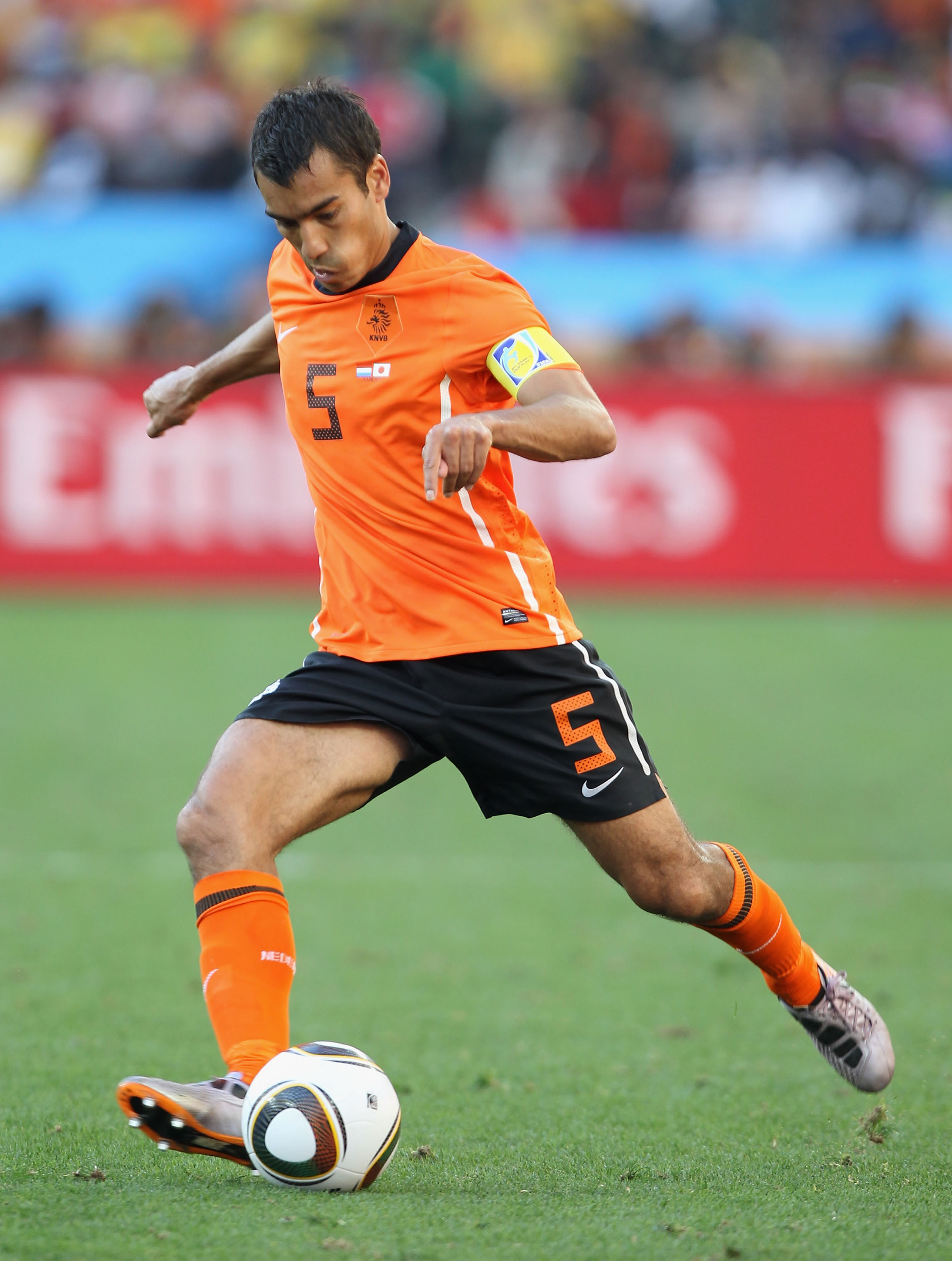
166. Giovanni VAN BRONCKHORST

POSITION: Defender

NATION: Netherlands (106/6)

CLUB(s): Feyenoord, RKC Waalwijk (Loan) (Both NED), Rangers (SCO), Arsenal (ENG), Barcelona

CLUB HONOURS: 2x SPL, 2x Scottish Cup, 1x Scottish League Cup, 1x Premier League, 2x FA Cup, 2x La Liga, 2x Supercopa Espana, 1x UEFA Champions League, 2x KNVB Cup;

INTERNATIONAL HONOURS: FIFA World Cup: Runner-Up 

"Van Bronckhorst was the epitome of the modern defender; dynamic, energetic, as comfortable going forward as he was in retreat, gifted technically and in possession of a fierce shot. If a little lightweight upon arrival, he soon bulked up to cope with the physical demands of the Scottish game."
Herald Scotland


165. Bruno CONTI


POSITION: Forward; 

NATION: Italy (47/5); 

CLUB(s): Roma, Genoa (Both ITA); 

CLUB HONOURS: 1x Serie A, 4x Coppa Italia; 

INTERNATIONAL HONOURS: 1x FIFA World Cup

"Bruno Conti is one of the true legends of the Italian game. Having spent his whole career at the same club he has a firm place in every Roma fan’s heart...He was Roma’s key man in them winning their second ever scudetto. In a team with the likes of Falcao, Agostino Di Bartolomei and Ruberto Puzzo, Conti shined, creating numerous goals and was the link between attack and defence...A model professional Bruno Conti will never be forgotten."
Richard Hinman - ForzaItalianFootball


164. Andoni ZUBIZARETTA


POSITION: Goalkeeper;

NATION: Spain (126/0);

CLUB(s): Alaves, Athletic Bilbao, Barcelona, Valencia (All ESP)

CLUB HONOURS: 6x La Liga, 3x Copa Del Rey, 3x Supercopa Espana, 1x UEFA European Cup, 1x UEFA Super Cup, 1x UEFA Cup Winners' Cup

"He had many qualities, including his level-headedness and superb positioning between the sticks. In 1986 he joined FC Barcelona as a replacement for the legendary Urruti. He was the mainstay of the famous 'Dream Team' and was, along with Koeman, the hero of the Wembley final with a series of miraculous, decisive interventions. Known as 'Zubi', he was also captain of the club for several seasons, and was noted both on and off the pitch for his serenity and psychological balance, which he was constantly able to transmit to the other players in order to get through the most difficult of match situations."
FCBarcelona.com 


163. Bixente LIZARAZU 


POSITION: Defender; 

NATION: France (97/2); 

CLUB(s): Bordeaux B (FRA), Bordeaux (FRA), Athletic Bilbao (SPA), Bayern Munich (GER), Olympique Marseille (FRA); 

CLUB HONOURS: 1x UEFA Intertoto Cup, 1x Ligue 2, 1x Intercontinental Cup, 1x UEFA Champions League, 5x Bundesliga, 5x DFB-Pokal, 4x DFB-Ligapokal; 

INTERNATIONAL HONOURS: 1x FIFA World Cup, 2x FIFA Confederations Cup, 1x UEFA European Championship

"A member of the brilliant French team that won the FIFA World Cup in 1998 and the UEFA European Championship in 2000, and with a highly distinguished career at Bayern Munich, Bixente Lizarazu has won just about everything there is to win in professional football. The man from the Basque country has always had a close relationship with the ocean, and is a huge fan of marine sports like sailing, stand-up paddle and of course, surfing. Since hanging up his boots, Bixente has been a keen surfer and is frequently to be found big wave riding. As a passionate defender of marine ecosystems, he set up the foundation Liza, pour une mer en Bleu and is involved with the Surfrider Foundation through various ocean-based initiatives."
BoardRiders-Week 


162. Ossie ARDILES


POSITION: Midfielder; 

NATION: Argentina (52/8); 

CLUB(s): Instituto de Córdoba (ARG), Belgrano (ARG), Huracán (ARG), Tottenham Hotspur (ENG), Paris Saint Germain (FRA), St George Saints (AUS), Blackburn Rovers (ENG), Queens Park Rangers (ENG), Ft. Lauderdale Strikers (USA), Swindon Town (ENG); 

CLUB HONOURS: 2x FA Cup, 1x UEFA Cup; 

INTERNATIONAL HONOURS: 1x FIFA World Cup

"An instantly popular cult hero for Tottenham Hotspur upon his arrival in 1978, Osvaldo Ardiles led the charge of foreign players to the English league. Fresh from a World Cup win with Argentina, the diminutive midfielder set a high standard for any other South American players hoping to follow his move. Known for his great work rate, perceptive reading of the game and ability to find the right pass, Ardiles quickly also got stuck into the physical side of the English game."
National Football Museum - Hall of Fame 


161. Mark VAN BOMMEL

POSITION: Midfielder;

NATION: Netherlands (79/10);

CLUB(s): Fortuna Sittard, PSV (Both NED), Barcelona (ESP), Bayern Munich (GER), Milan (ITA);

CLUB HONOURS: 4x Eredivise, 1x KNVB Cup, 4x Johan Cruyff Shield, 1x La Liga, 1x UEFA Champions League, 2x Supercopa Espana, 2x Bundesliga, 2x DFB-Pokal, 1x DFB-LigaPokal, 1x DFL Supercup, 1x Serie A, 1x Supercoppa Italia

INTERNATIONAL HONOURS: 1x FIFA World Cup Runner Up

"Holland have been known for their total football and free-flowing style of play for the last 40 years, however after numerous near-misses the defensive side began to become more integral. Mark Van Bommel was the finest example of this new ideology with his combative midfield displays for club and country over the last decade. His record of winning domestic titles in four different countries makes him stand out from the crowd and his dominant performances for Rijkaard's Barcelona in 2006 meant a UEFA Champions League was added to his illustrious honours." 
Ben Jones - TFHB 


Sabtu, 01 Februari 2014

10 Rekor Transfer Pemain Termahal Dunia

Dunia sepakbola sudah tidak bisa dipisahkan dari yang namanya bisnis dan uang. Tak jarang sebuah klub mengeluarkan uang dalam jumlah besar untuk membeli seorang pemain dari klub lain saat bursa transfer pemain dibuka. Beberapa klub kaya tak segan untuk membeli pemain yang bagus dan berkualitas dengan harga selangit. Contoh klub terkaya di dunia antara lain adalah Manchester City, Real Madrid, PSG, Chelsea, Barcelona dan lain-lain. Tim-tim tersebut selalu terlibat dalam pasar bursa pemain dan isu-isu gosip transfer pemain terbaru, baik transfer window Januari maupun Agustus. Pemain-pemain yang dibeli mahal tak hanya pemain yang sudah hebat, tapi juga beberapa pemain muda dan wonderkid terbaik dunia yang berpotensi menjadi pemain terbaik dunia beberapa tahun ke depan.

Dalam sejarah bursa transfer dunia, ada beberapa transfer besar yang dengan melibatkan uang trilliunan rupiah atau sekitar di atas 65 juta euro. Zinedine Zidane sempat memegang rekor pemain termahal dunia sejak 2001 hingga 2009 saat dibeli Real Madrid dari Juventus. Namun hal itu dipecahkan oleh Cristiano Ronaldo di tahun 2009 saat pindah dari Manchester United ke Real Madrid. Di tahun 2013, status pemain termahal dunia berganti lagi ke Gareth Bale, yang juga dibeli oleh Real Madrid kali ini dari Tottenham. Untuk status kiper termahal dunia dipegang oleh kiper asal Italia, Gianluigi Buffon (Parma ke Juventus), sedangkan untuk status bek termahal dunia masih menjadi milik bek Manchester United asal Inggris, Rio Ferdinand (Leeds ke Man United).

10 Rekor Transfer Pemain Termahal Dunia


1. Gareth Bale
Klub Asal : Tottenham Hotspur
Klub yang Dituju : Real Madrid
Harga : 100 juta euro (Rp 1,47 trilliun)
Kebangsaan : Wales
Posisi : Winger

2. Cristiano Ronaldo
Klub Asal : Manchester United
Klub yang Dituju : Real Madrid
Harga : 94 juta euro (Rp 1,38 trilliun)
Kebangsaan : Portugal
Posisi : Winger

3. Zinedine Zidane
Klub Asal : Juventus
Klub yang Dituju : Real Madrid
Harga : 75 juta euro (Rp 1,11 trilliun)
Kebangsaan : Prancis
Posisi : Playmaker

4. Zlatan Ibrahimovic
Klub Asal : Inter Milan
Klub yang Dituju : Barcelona
Harga : 69 juta euro (Rp 1,02 trilliun)
Kebangsaan : Swedia
Posisi : Striker

5. Kaka
Klub Asal : AC Milan
Klub yang Dituju : Real Madrid
Harga : 68 juta euro (Rp 1,01 trilliun)
Kebangsaan : Wales
Posisi : Playmaker

6. Edinson Cavani
Klub Asal : Napoli
Klub yang Dituju : PSG
Harga : 64 juta euro (Rp 953 milliar)
Kebangsaan : Uruguay
Posisi : Striker

7. Luis Figo
Klub Asal : Barcelona
Klub yang Dituju : Real Madrid
Harga : 62 juta euro (Rp 926 milliar)
Kebangsaan : Portugal
Posisi : Winger

8. Radamel Falcao
Klub Asal : Atletico Madrid
Klub yang Dituju : AS Monaco
Harga : 60 juta euro (Rp 896 milliar)
Kebangsaan : Kolombia
Posisi : Striker

9. Fernando Torres
Klub Asal : Liverpool
Klub yang Dituju : Chelsea
Harga : 58 juta euro (Rp 866 milliar)
Kebangsaan : Spanyol
Posisi : Striker

10. Neymar
Klub Asal : Santos
Klub yang Dituju : Barcelona
Harga : 57 juta euro (Rp 851 milliar)
Kebangsaan : Brazil
Posisi : Striker


Tambahan serba-serbi transfer pemain lainnya :

Rekor pemain termahal dunia :
2013-...       - Gareth Bale
2009-2013 - Cristiano Ronaldo
2001-2009 - Zinedine Zidane
2000-2001 - Luis Figo
1999-2000 - Hernan Crespo


Pemain termahal dunia berdasarkan posisi :

- Kiper termahal dunia - Gianluigi Buffon (Parma ke Juventus)
- Bek tengah termahal dunia - Rio Ferdinand (Leeds ke Manchester United)
- Bek kanan termahal dunia - Dani Alves (Sevilla ke Barcelona)
- Bek kiri termahal dunia - Fabio Coentrao (Benfica ke Real Madrid)
- Gelandang bertahan termahal dunia - Fernandinho (Shakhtar ke Manchester City)
- Winger termahal dunia - Gareth Bale (Tottenham ke Real Madrid)
- Playmaker termahal dunia - Zinedine Zidane (Juventus ke Real Madrid)
- Striker termahal dunia - Zlatan Ibrahimovic (Inter Milan ke Barcelona)


Pemain termahal dunia berdasarkan klub :

- Pemain termahal Barcelona - Neymar (dari Santos)
- Pemain termahal Real Madrid - Gareth Bale (dari Tottenham)
- Pemain termahal Manchester United - Juan Mata (dari Chelsea)
- Pemain termahal Arsenal - Mesut Ozil (dari Real Madrid)
- Pemain termahal Chelsea - Fernando Torres (dari Liverpool)
- Pemain termahal Manchester City - Sergio Aguero (dari Atletico Madrid)
- Pemain termahal Liverpool - Andy Carroll (dari Newcastle)
- Pemain termahal Juventus - Gianluigi Buffon (dari Parma)
- Pemain termahal AC Milan - Manuel Rui Costa (dari Fiorentina)
- Pemain termahal Inter Milan - Christian Vieri (dari Lazio)
- Pemain termahal Bayern Munchen - Mario Gotze (dari Dortmund)
- Pemain termahal Borussia Dortmund - Henrikh Mkhitaryan (dari Shakhtar)
- Pemain termahal AS Roma - Gabriel Batistuta (dari Fiorentina)
- Pemain termahal PSG - Edinson Cavani (dari Napoli)
- Pemain termahal AS Monaco - Radamel Falcao (dari Atletico Madrid)
- Pemain termahal Tottenham Hotspur - Erik Lamela (dari AS Roma)
- Pemain termahal Atletico Madrid - Radamel Falcao (dari FC Porto)


Pemain termahal dunia berdasarkan negara :

- Pemain termahal Brazil - Neymar (Santos ke Barcelona)
- Pemain termahal Italia - Gianluigi Buffon (Parma ke Juventus)
- Pemain termahal Inggris - Andy Carroll (Newcastle ke Liverpool)
- Pemain termahal Argentina - Sergio Aguero (Atletico ke Manchester City)
- Pemain termahal Belanda - Marc Overmars (Arsenal ke Barcelona)
- Pemain termahal Jerman - Mesut Ozil (Real Madrid ke Arsenal)
- Pemain termahal Prancis - Zinedine Zidane (Juventus ke Real Madrid)
- Pemain termahal Spanyol - Fernando Torres (Liverpool ke Chelsea)
- Pemain termahal Portugal - Cristiano Ronaldo (Man United ke Real Madrid)


Pemain termahal dunia berdasarkan tahun :

- Pemain termahal tahun 2014 - Juan Mata (Chelsea ke Man United)
- Pemain termahal tahun 2013 - Gareth Bale (Tottenham ke Real Madrid)
- Pemain termahal tahun 2012 - Lucas Moura (Sao Paulo ke PSG)
- Pemain termahal tahun 2011 - Fernando Torres (Liverpool ke Chelsea)
- Pemain termahal tahun 2010 - David Villa (Valencia ke Barcelona)
- Pemain termahal tahun 2009 - Cristiano Ronaldo (Man United ke Real Madrid)
- Pemain termahal tahun 2008 - Robinho (Real Madrid ke Manchester City)


Itulah informasi update tentang rekor 10 transfer termahal dunia untuk pemain sepakbola dan serba-serbi lain seperti pemain termahal berdasarkan posisi, klub, tahun serta negara. Kita tunggu saja gebrakan dan aktivitas tim-tim kaya dan besar di dunia dalam bursa transfer selanjutnya. Semoga informasi tersebut bermanfaat.


(zakipedia)

Entri Populer

Diberdayakan oleh Blogger.


© 2013 TOPSCORE AND NEWS. All rights resevered. Designed by Templateism

Back To Top